iPhone Duo vs Samsung Galaxy Z Fold 8: What’s the Difference?
Foldables are now serious premium-phone choices, and New Zealand buyers have two very different approaches to the format. If you want one device to cover both phone and small-tablet duties, the decision affects productivity, travel, photography, and long-term ownership cost. That also makes factors such as durability, parts availability, and access to Mobile Phone Repair Services in NZ more relevant than they are with many conventional smartphones.
This iPhone Duo vs Galaxy Z Fold 8 guide compares official NZ pricing, displays, design, software, cameras, battery claims, and ownership factors so you can judge which foldable better matches your routine.
1. Design differences change how each foldable feels every day
The first meaningful difference in iPhone Duo vs Samsung Galaxy Z Fold 8 is portability. Apple lists the Duo at 254g and 11.3mm thick when folded. Samsung lists the Fold8 at 201g and 9.7mm thick when folded. A 53g gap is noticeable during one-handed use or all-day carry.
Apple puts more emphasis on sealing and premium materials
The Duo uses a titanium frame and hinge cover, Ceramic Shield 2 on the front and Ceramic Shield on the rear. Apple also gives it an IP68 rating, tested for water resistance to a maximum depth of six metres for up to 30 minutes. That is a strong published protection rating for a foldable.
Samsung wins the weight battle
Samsung uses an Armor Aluminum frame, Gorilla Glass Ceramic 3 on the front and Victus 2 on the rear. Its biggest ergonomic advantage is weight: at 201g, it is considerably lighter than Apple’s first foldable. For frequent one-handed use, that difference may matter more than frame materials.
2. The displays are similar in size but different in purpose
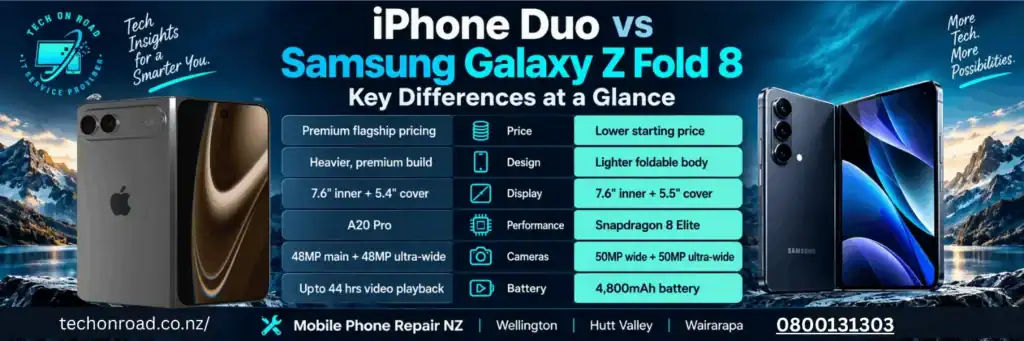
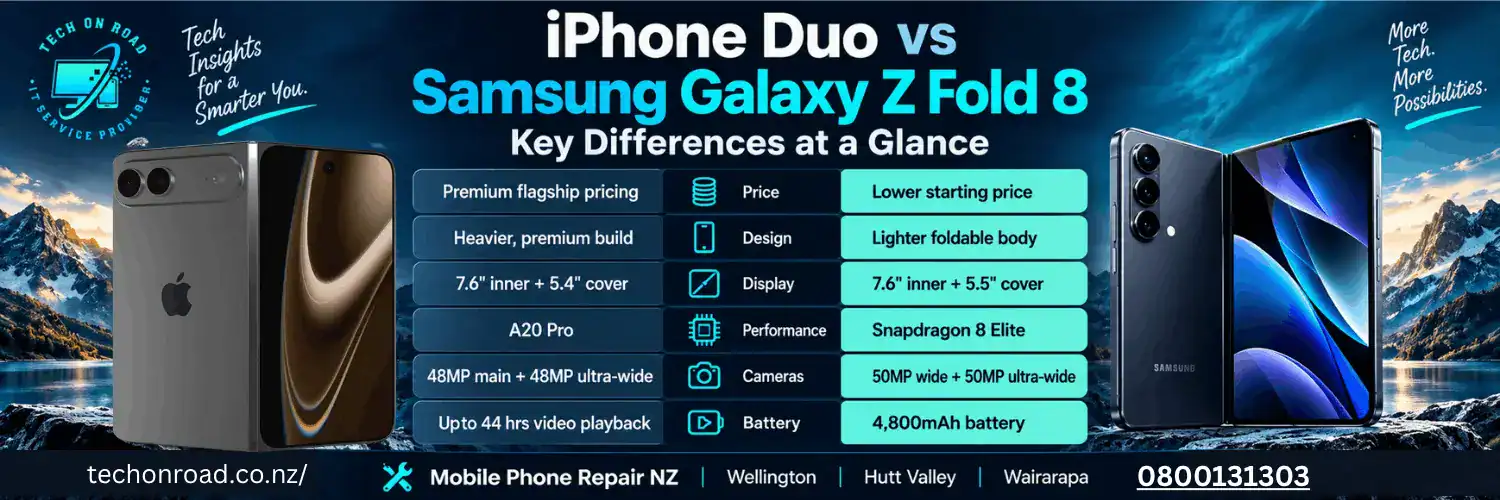
Both devices open to a 7.6-inch-class experience, yet iPhone Duo vs Galaxy Z Fold 8 differs in how those screens are used. Apple expands the iPhone interface onto a larger canvas; Samsung builds around established Android foldable multitasking.
Apple keeps the iPhone experience visually familiar
The iPhone Duo display is a 7.6-inch Super Retina XDR folding OLED with ProMotion up to 120Hz. The 5.4-inch outer OLED also supports ProMotion and Always-On functionality. Apple lists outdoor peak brightness of 3,000 nits on both displays and supports Apple Pencil (USB-C).
Samsung focuses on flexible layouts
The Galaxy Z Fold 8 display measures 7.6 inches inside, paired with a 5.5-inch cover screen. Samsung promotes a 10:16 cover ratio for normal scrolling and a 4:3 inner ratio for reading, video and side-by-side work. If your iPhone Duo comparison is productivity-led, test whether you genuinely use multiple apps at once.
3. Software and performance matter more than headline benchmark numbers
The iPhone Duo vs Samsung Galaxy Z Fold 8 decision is also an ecosystem choice. Apple uses the A20 Pro; Samsung uses the Snapdragon 8 Elite Gen 5 for Galaxy and pairs it with Galaxy AI and mature multi-window features.
For iPhone Duo vs Galaxy Z Fold 8, consider the workflow you already own:
- Apple-heavy setup: A Mac, Apple Watch, iCloud, AirDrop and FaceTime make the Duo easier to integrate.
- Multitasking-first setup: Samsung’s established split-screen approach gives Android power users more visible control over multiple apps.
- Long software horizon: Samsung promises up to seven generations of Android upgrades and seven years of security updates.
- Stylus use: Apple officially supports Apple Pencil (USB-C) on the Duo.
Treat Apple foldable vs Samsung as a workflow comparison, not a loyalty test.
4. Cameras and battery require more than a megapixel comparison
The cameras look close on paper, but iPhone Duo vs Galaxy Z Fold 8 approaches creation differently. Apple stresses computational photography and Dolby Vision; Samsung adds foldable previews, ProVisual processing and Dual Recording.
Camera hardware and creator tools
The iPhone Duo camera system uses 48MP main and 48MP ultra-wide sensors, with up to 2x optical-quality zoom. Samsung uses 50MP wide and 50MP ultra-wide rear sensors, plus 10MP cameras on both the cover and main displays. Samsung also offers up to 10x digital zoom.
For creators, decide whether Apple’s video workflow matters more than Samsung’s dual-screen preview and Android editing flexibility.
Battery claims are not directly comparable
Apple does not publish a simple mAh figure for the iPhone Duo battery. It claims up to 44 hours of video playback using the outer display and up to 31 hours using the inner display. Samsung lists a 4,800mAh typical Z Fold 8 battery and up to 26 hours of video playback. Because test methods differ, do not treat those figures as a direct endurance benchmark.
5. iPhone Duo vs Samsung Galaxy Z Fold 8 pricing in NZ creates the clearest commercial difference
The iPhone Duo price vs Z Fold 8 gap is substantial. Apple lists the Duo at NZ$4,199 for 256GB, NZ$4,599 for 512GB, NZ$5,399 for 1TB and NZ$6,599 for 2TB. Samsung launched the standard Fold8 at NZ$3,099 for 256GB, NZ$3,499 for 512GB and NZ$4,299 for 1TB.
At 256GB, iPhone Duo vs Galaxy Z Fold 8 starts with a NZ$1,100 difference. Apple adds a 2TB tier, but buyers should calculate total ownership cost rather than storage price alone.
Include insurance, cases, chargers, trade-in value, and repair costs. This is particularly relevant in regional areas, where access to specialist repair support may differ.
At Tech On Road, we provide mobile phone repair NZ services across Wellington, Hutt Valley, Wairarapa, and their surrounding sub-regions (Petone, Carterton, Masterton, Greytown, Martinborough,Featherston etc). One practical consideration we regularly see with device repairs is that the exact model, damaged component, and replacement-part availability can significantly affect the repair route.
Checking these factors in advance can help buyers understand the longer-term ownership implications of an expensive foldable.
Which phone fits different types of buyers?
A best foldable phone 2026 search suggests one universal winner, but iPhone Duo vs Galaxy Z Fold 8 is more useful when matched to real use cases.
- Existing Apple ecosystem: The Duo has the smoother path for people deeply invested in Apple devices and services.
- Frequent multitasker: Samsung’s mature foldable software is designed around side-by-side work and flexible windowing.
- Weight-sensitive buyer: The Fold8’s 201g body is a major advantage for prolonged handheld use.
- High-capacity storage buyer: Apple goes to 2TB; Samsung’s standard Fold8 tops out at 1TB.
- Value-focused premium buyer: Samsung starts NZ$1,100 lower at 256GB based on official NZ launch pricing.
- Water-resistance-focused buyer: Apple’s stated IP68 protection is a meaningful specification to consider.
For shoppers comparing a foldable iPhone vs Samsung device, daily compromises matter more than the longest feature list.
Check these ownership details before you place an order
Before spending more than NZ$3,000, iPhone Duo vs Galaxy Z Fold 8 buyers should verify the ownership details that matter after launch excitement fades.
Apple’s Duo is eSIM-only, while Samsung lists Nano-SIM and eSIM support. That matters if you swap physical SIMs. Apple’s device reaches New Zealand on 23 October 2026, with pre-orders from 17 October, so long-term independent durability evidence is not yet available.
If you are searching for the best foldable phone NZ, handle both before buying. Type on the cover screen, hold each for several minutes, test two apps together and check your banking, work and travel apps.
The same principle applies to iPhone Duo vs Samsung Galaxy Z Fold 8 shopping: judge the daily experience, not just the launch presentation.
Choose the foldable that removes more friction from your day
The strongest way to resolve iPhone Duo vs Samsung Galaxy Z Fold 8 is to rank your priorities before brand preference. Apple offers a tightly integrated first-generation foldable with IP68 protection, a 2TB storage ceiling, strong video tools and familiar iOS continuity, but it costs more and weighs considerably more. Samsung offers a lighter body, lower starting price, mature foldable multitasking and more flexible SIM support. In other words, iPhone Duo vs Galaxy Z Fold 8 has no meaningful answer without your priorities.
If Apple ecosystem continuity and a large iPhone canvas lead your list, the Duo makes sense. If portability, mature foldable software and price matter more, Samsung offers a different balance. Rank the three factors—ecosystem, weight, multitasking, cameras, durability, storage or price—that will still matter after the novelty wears off.